The Automotive Landscape
The automotive industry is entering the era of Software-Defined Vehicles (SDVs), where vehicles’ features and functions are predominantly driven by software. Users expect the same convenience from their vehicles as their smartphones, demanding access to the latest features and updates without dealership visits.
SDVs rely on centralized domain control units, enabling frequent software releases while decoupling hardware and software development cycles. However, managing the complexity of software in vehicles with numerous Electronic Control Units (ECUs) presents challenges. This places pressure on OEMs to deliver updates while ensuring reliability and security. A Centralized domain control unit incorporates powerful computers for various vehicle functions, managed by an embedded software layer. However, as vehicle functions become automated, risks such as independent braking or steering arise, rigorous testing and realistic assessments become required.
The Solution for All
The complexity of ECUs in modern vehicles is growing rapidly. This raises the bar for reliable validation, necessitating new testing methods, including virtualization.
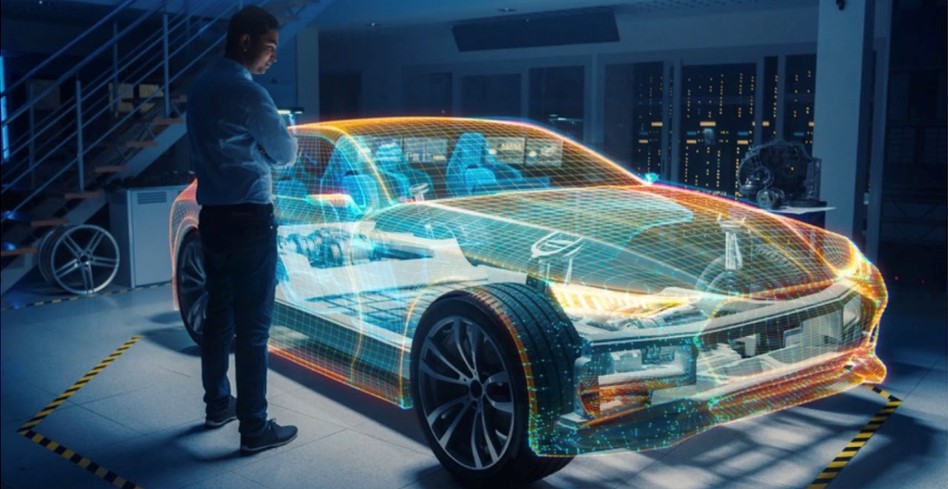
Validation cannot occur in isolation and often occurs late in the development process. Traditional methods struggle to keep pace as software development remains tightly coupled with hardware development. Digital Twins with Virtual ECU come to the rescue.
vECU accelerates hardware and software development, shortening product timelines from years to weeks and enabling faster delivery of new technologies. It supports code reusability across models, decreasing redundancy and costs. Standardized software boosts efficiency and innovation in the automotive industry.
Achieving start of production (SOP) with accelerated development is not sufficient; the ability to continuously validate and deliver software updates via Over-The-Air (OTA) updates has emerged as a critical differentiator.
What is vECU?
The essential components for vECUs include replicating realistic scheduling behavior, which involves simulating timing and triggering information, and actions like preemption and interruption by the operating system. Additionally, it’s crucial to integrate a comprehensive software architecture to validate interface compatibility, identify data discrepancies, and ensure compliance with standards.
Establishing simulated bus connectivity is key for testing ECU communication, with options to generate or substitute the real stack simplifying testing procedures. For AUTOSAR Classic Platform users, a vECU should include the application layer, AUTOSAR Runtime Environment (RTE), and OS, with flexibility for integrating basic software modules (BSWs) for simulation purposes.
The importance of Virtual ECU to accelerate Software-Defined Vehicles era?
vECUs are revolutionizing the landscape by expediting the validation process for OTA updates, enabling early software deployment, and integrating into agile methodologies. They offer enhanced system testing ensuring deterministic issue reproduction and debug visibility. Additionally, vECUs facilitate functional safety and security validation, leveraging features such as fault injection. Their software nature ultimately simplifies supply chain collaboration.
End-users can personalize their driving experience, receive seamless updates through OTA capabilities, Advanced Driver Assistance Systems (ADAS), and AI assistants. Software-Defined Vehicles (SDVs) can also optimize performance using AI and machine learning.
Level of vECU
Understanding the capabilities and limitations of vECUs involves considering the different abstraction levels they offer.
Level 0: Core software algorithms without hardware dependencies, suitable for initial code validation.
Level 1: ECU application production code without middleware or OS, for realistic testing.
Level 2: Includes middleware, testing software interactions with ECU components and protocols.
Level 3: Full middleware and partial OS for a near-identical ECU testing environment.
Level 4a: Host-based implementations for enhanced performance and flexibility.
Level 4b: Full production software with virtual hardware access on the host, closest to real ECU emulation.
The future of vECU
As the automotive industry embraces new technologies, vECUs will play an increasingly crucial role. Advancements in virtual modeling and simulation will further enhance the capabilities of vECUs, enabling even more comprehensive and realistic testing scenarios.
Sources:
(Micronova, n.d.)
(Mudduluru, n.d.)
(dSPACE, n.d.)

 20-11-2024