The road to software-defined vehicles is paved with innovative E/E architecture. OEMs and chipmakers, make strategic choices now!
Today’s car market is all about digital features, just like smartphones. Features like self-driving cars, internet connectivity, electric power, and car sharing (ACES) are what consumers crave. To meet these demands, cars need to constantly update software, connect to digital services, and give drivers easy access to data. This is where electrical/electronic (E/E) architecture and software design come in – they’re the key to reshaping the entire car and chip-making industries.
Car E/E architectures have gone from basic setups with separate ECUs for each function, to a growing number of interconnected ECUs. Lately, domain-centralized architectures emerged, replacing multiple ECUs with a few powerful domain computers.
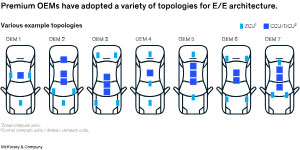
The latest (5th generation) introduces zonal controllers and central computer units (see Exhibit 1). This design has the potential to handle more ECUs and simplify software but creates challenges for carmakers like latency and optimal ECU topology (placement), where industry designs differ greatly. This article dives into these trends and proposes strategies for players in the automotive industry.
Pictures 1
Harnessing the Power of 5th generation architecture to Drive Automotive Innovation
The biggest advantage of the latest architecture is simplifying the ECU layout. However, automakers need to consider different technical approaches during the switch. Here are the four key benefits:
- Easier Software Updates (OTA): Many ECUs can create update bottlenecks and complexity, making it harder to ensure safety, reliability, regulations, and software authenticity. Zonal architecture consolidates these units, simplifying updates and allowing rollbacks if updates fail.
- Independent Hardware and Software Development: Separating hardware and software can speed up development. Zonal controllers, using software abstraction layers, can combine functions previously handled by separate ECUs. This reduces reliance on specific suppliers, shortens development times, and allows for faster innovation.
- More Powerful and Efficient Processors: Zonal controllers consolidate the functions of multiple ECUs. Smaller chip sizes improve power efficiency. New “system-on-chip” (SoC) designs combine central processing units (CPUs), memory, and specialized hardware accelerators. These accelerators enable precise data routing and independent processing. It’s no surprise then, that the latest SoCs for zonal controllers use chip sizes of 16 nanometers (nm) or smaller.
- Simpler Wiring: Zonal controllers act as data input/output (I/O) hubs, often placed at the car’s edge. This allows for a less complex wiring harness. This, in turn, promotes standardization, simplifies production automation, and lowers costs due to less specialized wiring skills needed. Considering that wiring harnesses can account for 20% of a car’s E/E architecture budget, this is a significant benefit.
The Zonal Controller Conundrum: Selecting the Most Cost-Effective Architecture
When designing zonal controllers, automakers and suppliers need to consider different use cases and applications to find the best fit for their needs. Here are four emerging approaches, each offering unique benefits at varying costs:
– Basic I/O Aggregators: In the simplest form, zonal controllers act as gateways, relaying information between sensors and actuators and the car’s central processing unit (CPU). This simplifies the wiring harness at the car’s edge. However, for safety-critical applications, latency (delays) can be an issue. To address this, dedicated hardware for routing and switching data is often needed, offloading some work from the main CPU.
– I/O with Power Control: This builds upon the basic design by adding power control and distribution capabilities. Smart fuses enable precise power delivery to different vehicle areas, allowing trade-offs between safety and comfort features. Additionally, it allows for predictive load balancing and comprehensive monitoring of circuit parameters. This approach offers new ways to control and measure power flow, enabling features to be powered on or off individually instead of the entire car. This can lead to improved range and valuable data insights.
– I/O with Computing Power: Zonal controllers can also include processing capabilities, particularly relevant for emerging “satellite sensors.” These sensors separate the physical sensor unit from the processing unit that interprets its raw signals. This allows for simpler, more affordable sensors that can be easily replaced if damaged. Meanwhile, the more expensive processing unit is safely housed within the car’s interior.
– The All-in-One Zonal Controller: This combines all the functionalities mentioned above, making it the most advanced and expensive option. Interestingly, a recent McKinsey survey suggests that 53% of experts believe this will eventually become the dominant model.
The E/E Revolution: How Zonal and Central Architectures Are Transforming Industry Dynamics
Car manufacturers (OEMs), major suppliers (Tier-1 players), and chip makers face critical decisions in implementing new electrical/electronic (E/E) architectures, considering various factors across the value chain.
They must understand which vehicle domains will be affected, identify strategic positions, and recognize that different domains have different requirements, with zonal controllers being suitable for areas like body control, powertrain, and chassis. (Exhibit 4 shows this visually).
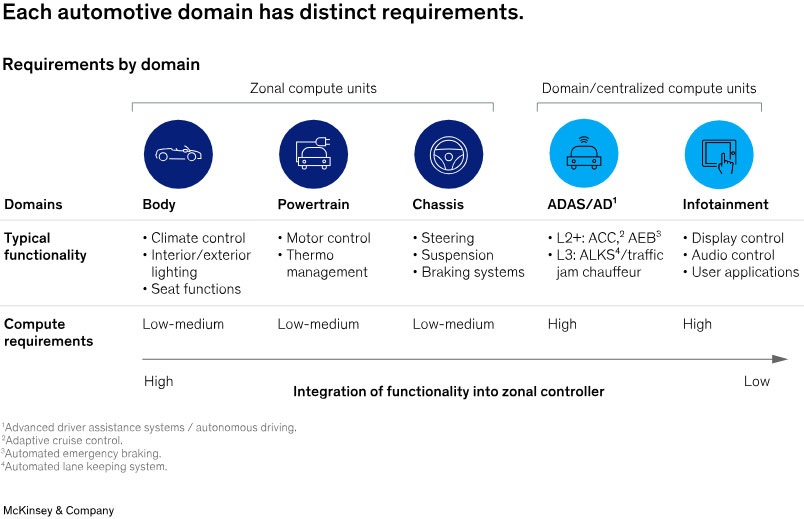
Exhibit 4
The shift to zonal and central computer architectures in car E/E systems presents opportunities and challenges across the automotive value chain:
- Domains with High Compute Needs: ADAS, AD, and infotainment require significant processing power, likely necessitating dedicated central or domain compute units.
- Software and Middleware: Various domains require different software stacks, emphasizing the importance of automotive middleware solutions and the adoption of SOA for flexibility.
- Collaboration and Integration: Zonal and central compute units may accelerate the breakdown of functional silos, requiring deeper collaboration between tier-1 suppliers and OEMs.
- New Ecosystems and Standards: Expect the formation of new industry ecosystems and standards, particularly for non-differentiating elements of automotive hardware and software.
- Semiconductor Considerations: Semiconductor companies will focus on scalable computer platforms and explore collaboration models, with chiplets becoming more common.
- Supply Chain Resilience: Capacity reservations may become more common, and foundries are expected to play a larger role in the automotive sector.
- Tier-1 Competition and In-Sourcing: Tier-1 suppliers will compete in architecture design, while OEMs may focus on in-sourcing and customization, potentially leading to directed-buy arrangements.
- Software Skills as a Differentiator: Strong software skills will be crucial, providing a competitive edge for companies.
- Balancing Costs and Benefits: To meet customer demands, the automotive value chain must embrace zonal and central architectures while carefully balancing costs and benefits for optimal transition models over time.
Reference source:
Getting ready for next-generation E/E architecture | McKinsey

 09-11-2024